A família Azarakhsh
183 years, four generations, devoted to the Persian rug
Farshkadeh Azarakhsh is a family: a lineage that has given one hundred and eighty-three years of its life to the handmade Persian rug, and whose fourth generation carries that path forward today. In our family, knowing rugs has passed from one generation to the next. Our elders taught us to take our time looking at a carpet, to remember the name and place of the people who wove it, and, when we entrust it to a home, to feel answerable for that family's choice and trust.
For us this calling is a cultural duty. The history and culture of Iran matter more to the Azarakhsh family than anything else. Our attachment to rugs is part of our love for the art of the people of this land. As much as we treasure the delicacy of a flower woven into a carpet, we hold dear the engraver's line on a copper dish, the sweep of a brush across a pottery bowl and the bright stitches of Baluch needlework. Each of these works keeps something of the lives of the people of its time: the colours they loved, the flowers that grew around them, the patterns they inherited from a mother or a master.
When we speak of Iran's two and a half thousand years of history, from the Achaemenids to today, we think of a land whose civilisation is rooted even deeper. Part of that history we read in rock reliefs; part of it we still see in daily life — in the poems we know by heart, in the festival we hold each spring and in the rug we spread at home. For our family, honouring history begins here: in knowing what has come down to us and caring for what we will hand on.
In the Shahnameh, Ferdowsi set the tales of Iran's heroes and people into verse so well that, a thousand years on, their names and stories are still on our lips. Damavand belongs to those tales too: in the story of Fereydun, it is where Zahhak is bound in chains, the sign that his age of tyranny is over. We find it beautiful that the name Damavand brings to mind both a white peak in the Alborz and a story that generations before us heard and retold to their children. The same bond between a land and its people's imagination can be seen in the Persian rug, where the weaver builds a garden full of water and trees knot by knot, so that even in the depth of winter a garden lies spread in the home.
Many hands have a share in every carpet. The designer must know how far a branch rising from the border will carry the eye into the field. The dyer must foresee how the blue of a flower will look beside the ground colour. And the weaver works for days and months, at very close range, on a part of a design that is seen whole only when the rug comes down from the loom. Our task, when we present a piece, is to speak of these artists' work too, so the buyer knows how much skill, patience and experience lie behind what is spread before them.
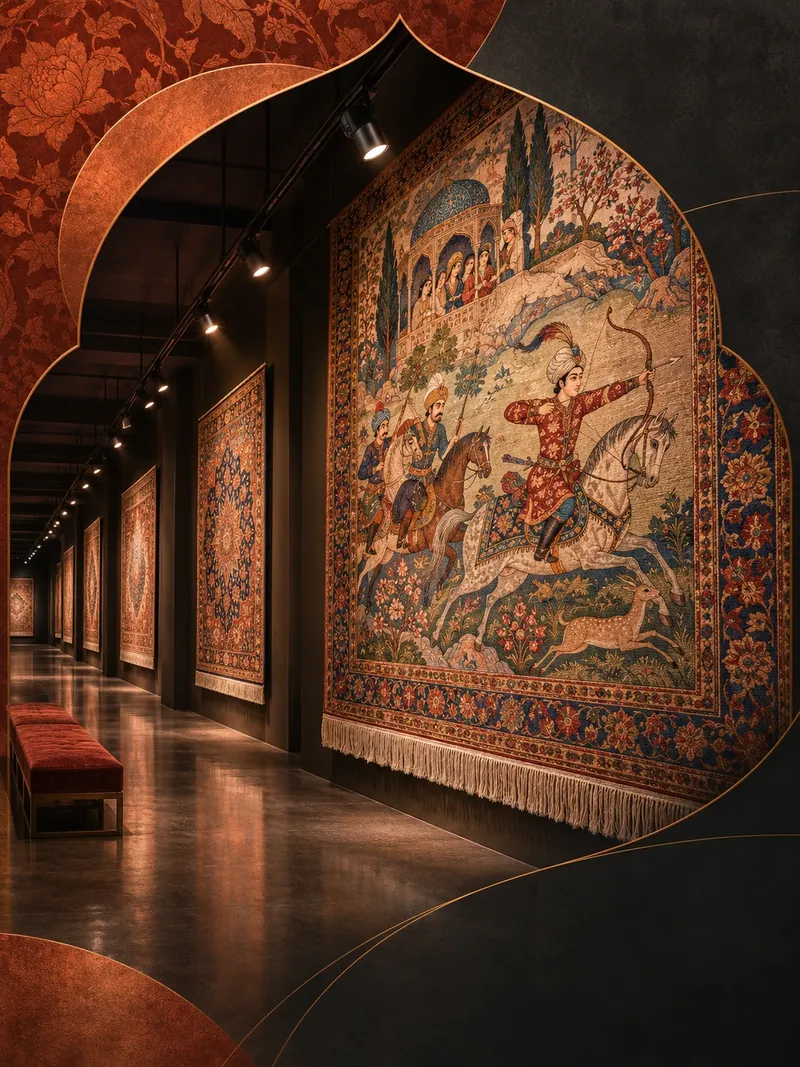
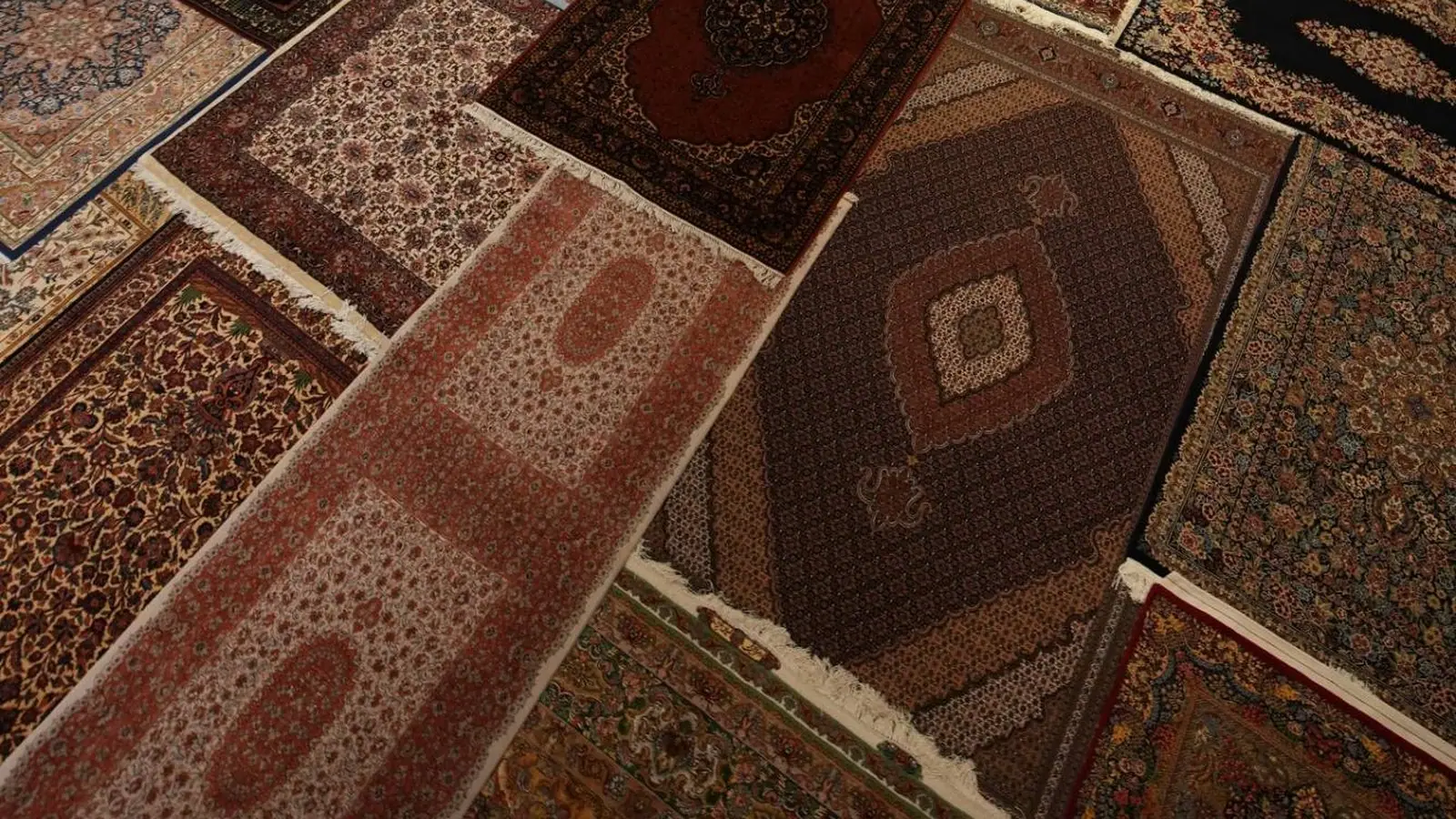
Behind the Azarakhsh treasury stands our family's relationship, across generations, with the weavers and master craftsmen of the Persian rug. That bond has given us rare access to fine pieces and has taught us to understand each work within the weaving tradition of its birthplace. In the Azarakhsh galleries, from Tabriz and Isfahan to Nain and Qom, many tellings of the Persian rug can be seen side by side. Sometimes the eye lingers on the fine detail of a Tabriz carpet, sometimes the calm colours of a Nain hold it, and sometimes it is enough to walk from one side of a Qom silk rug to the other to see a new colour rise from the same pile as the light changes direction.
Every rug is examined carefully before it enters the Azarakhsh treasury. The fibre, the quality and soundness of the weave, the harmony of the colours and the fit of the design to the rug's size all weigh in our choice. With older rugs we also read the marks the years have left on weave and colour. It matters to us that a rug's new owner knows what they are taking home, what gives it its value and how to care for it. That is why every rug leaves for its new home with its own certificate of authenticity.
Today, with three galleries in Iran and two abroad, Farshkadeh Azarakhsh is among the leaders of the art and craft of the handmade rug. Being present beyond Iran's borders means something special to us. Sometimes a visitor's first acquaintance with a city in Iran begins with a rug woven in that very city, and we would like them, whenever they remember that rug, to remember the name of its birthplace too. It is our pride that wherever in the world a piece from this treasury is spread, it carries the name of Iran and the art of its people with it.
In the Azarakhsh galleries, choosing a rug begins with a conversation about your home: the light in the room, the size of the space, the colours you love and where the rug will sit in your daily life all shape the choice. We would like you to have the chance to see the weave up close, then step back a few paces and take in the design as a whole. Our hope is that years from now, as you walk through the door, the rug you chose will still bring back the pleasure of that first look.
Our care continues after the purchase. From advice on looking after your rug to washing, restoration and appraisal, we stay beside you and your rug for years. We know that the carpet you choose today will, in time, be woven into the memories of the people and days of that home. Perhaps one day your child will spread it in their own home and, seeing a corner of its design, remember where their father or mother used to sit. For four generations the Azarakhsh family has worked for exactly this kind of permanence: so that the Persian rug, true to itself and to the memory of the people who made it, passes from one home to the next and from one generation to another.
Agende uma visita privada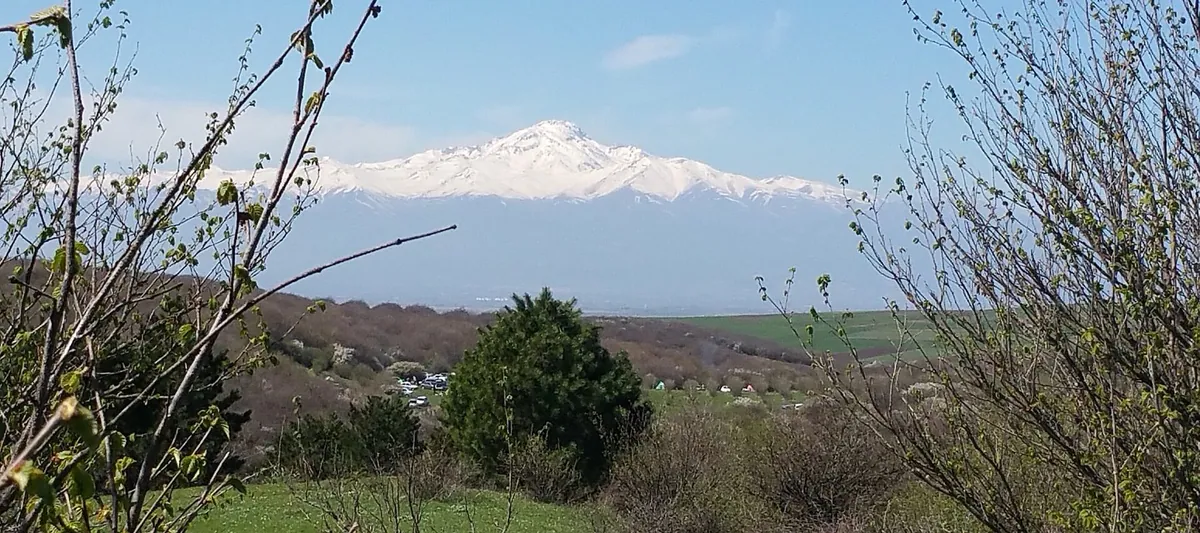
Ardabil: the land of Sabalan, birthplace of the Safavids
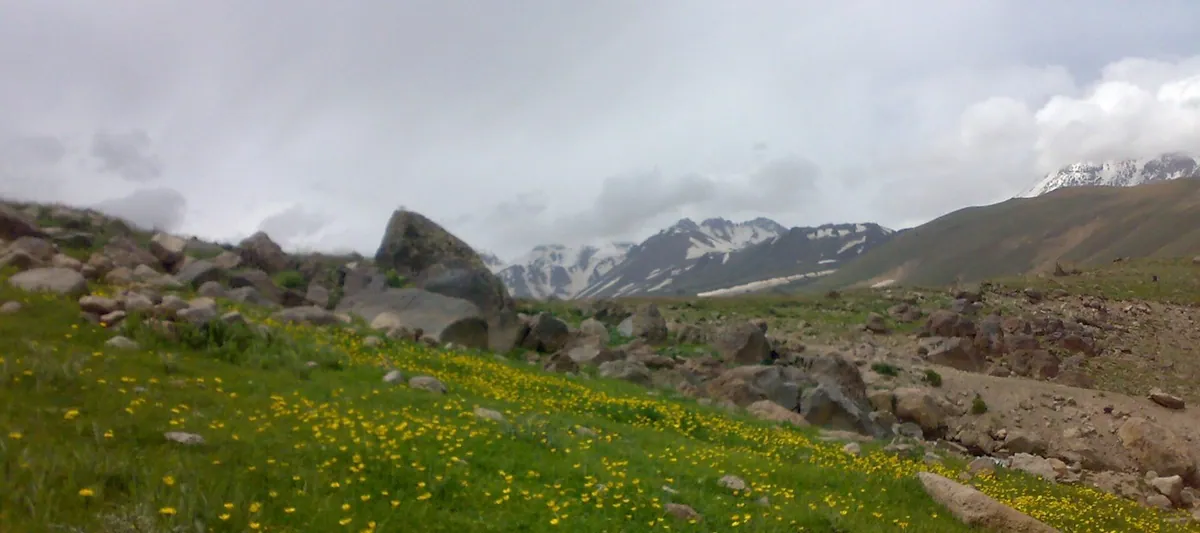
In Ardabil, Sabalan is called “Savalan”. That local name may be the best way into the city. For the people of Ardabil, Savalan is the mountain that still shows snow on its heights after the plain has warmed, and on whose slopes the summer pastures of the nomads come to life. The city stands on a high plain in north-western Iran, and the mountain, about forty kilometres to the west, sits on Ardabil’s horizon. Between that plain and that peak, part of the history and culture of Iranian Azerbaijan took shape.
Sabalan and the seasons of Ardabil
Ardabil has long, cold winters and short, cool summers. Spring does not reach the plain and the mountain at the same time: when the plain turns green, it is still winter on the heights of Sabalan. At about 4,800 metres, Sabalan is one of the highest mountains in Iran. A small lake, frozen most of the year, lies in the volcanic crater at its summit. Lower down, on the same mountain’s slopes, hot water rises from the ground; the springs of Sarein are among the best-known signs of this mountain landscape.
For the Shahsevan nomads, the seasons have long set the time to move. As the weather warmed, nomad families drove their flocks from the winter quarters of the Moghan plain up to the pastures of Sabalan, and took the road back to the plain before the cold returned. That is why, in Ardabil’s cultural geography, Moghan and Sabalan belong together: one was the flocks’ winter refuge, the other their summer pasture. Herding and nomadic weaving are part of this same way of life.
The language and culture of Ardabil
Most people in the city speak Azerbaijani Turkish in its Ardabil accent. You hear it at home and in the bazaar, in family stories and in the songs of the ashiqs. An ashiq is at once musician, singer and storyteller, carrying the tale forward with his instrument and singing the verses to listeners who sometimes heard the story from the generation before. Part of the memory of the people of Azerbaijan has reached later generations in just this way, by being heard and retold.
One of the rites with which Ardabil welcomes Muharram is tasht-gozari, the placing of the basins. In the last days of Dhu al-Hijja, people of each neighbourhood gather and set basins of water in the mosques; the water recalls the thirst of Karbala. To know the city’s culture, these local gatherings matter as much as its historic buildings. Each generation learns the custom by being there and joining the elders of the neighbourhood.
From ancient Ardabil to the Safavid age
Ardabil’s history began centuries before the Safavids. Old accounts attribute the city’s founding to the Sasanian era, and in the first Islamic centuries Ardabil was one of the main centres of Azerbaijan. Later, its place on the caravan routes brought prosperity to its bazaar and craftsmen; nineteenth-century travellers wrote of the bustle of the Ardabil bazaar and of merchants who came to the city from other lands.
Another chapter of the city’s history began with Sheikh Safi al-Din Ardabili, a mystic of the 13th and 14th centuries. He founded the Safavid order in Ardabil, and his khanqah became a place where disciples met and gathered. Several generations later Shah Ismail I, his descendant and a native of Ardabil, was crowned in Tabriz in 1501 and made that city the capital of the Safavid state. Ardabil kept its special place as the family’s birthplace, and Safavid kings, reign after reign, embellished their ancestor’s tomb.
Today the khanqah and shrine ensemble of Sheikh Safi al-Din Ardabili, in the heart of the city, is the legacy of that age. On the brick body of the tomb tower the name “Allah” is repeated in turquoise tiles, giving it the name “Allah-Allah dome”. In the Chini-khaneh, the refinement lies in the niches made to hold porcelain. From the dome’s outer face to the details of the inner walls, the hands of several generations of artists can be seen in this building. The ensemble was inscribed on the UNESCO World Heritage List in 2010.
The Ardabil Carpet, a legacy of Iran’s weavers
Of all the works that have carried this city’s name around the world, the Ardabil Carpet has a special meaning for us at Farshkadeh Azarakhsh. This great Safavid carpet, now in the Victoria and Albert Museum in London, was most probably commissioned by the court for the shrine of Sheikh Safi. Its deep blue field is covered with winding stems and delicate flowers. A great medallion sits at its centre, and on either side of it two lamps are woven; the weavers even made the two lamps different in size, a detail that still holds the eye after nearly five centuries.
In the border, among all these colours and patterns, the name “Maqsud Kashani” and the date 946 AH, that is 1539–1540, are woven. Those few words let us know to this day when the work was made. For us at Farshkadeh Azarakhsh, introducing Ardabil leads straight to introducing the Persian rug. When we speak of a carpet, we also remember the people who dyed the wool, drew the design and sat for years at the loom. Not all their names are on the border, but the fruit of their work is still known by the name of Ardabil.
A história do Tapete de ArdabilSources: Encyclopaedia Iranica · Irangaah · UNESCO · V&A
Fotos: F4fluids (CC BY-SA 3.0) · Reza babaeian (CC BY-SA 3.0)