 Rug knowledge · 2026-11-02
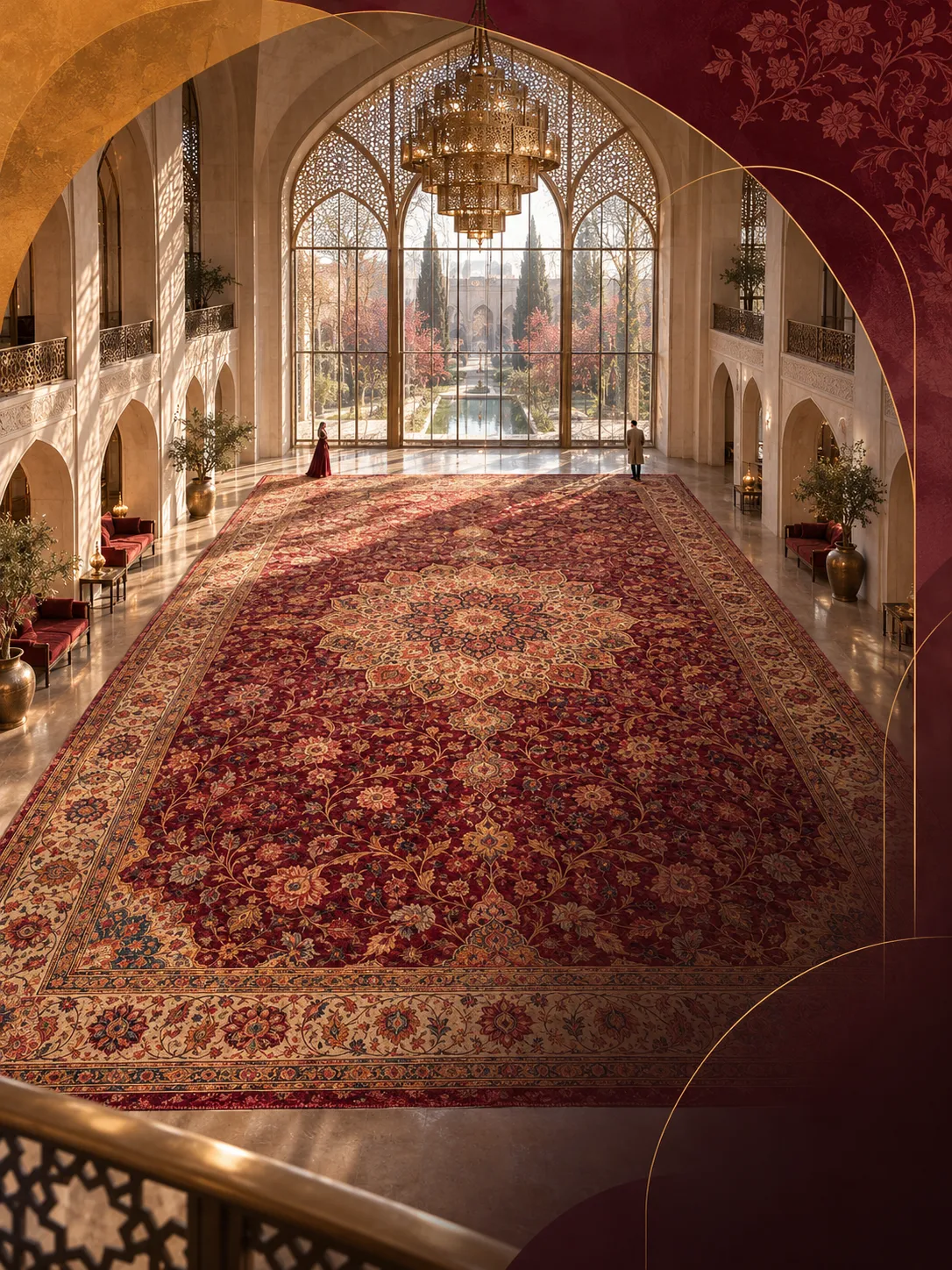
The Baharestan Carpet, also known as the Spring of Khosrow, is one of the most legendary carpets in history. It was kept in the Sasanian royal palace at Ctesiphon. Nothing of it survives: all we know comes from the historians.
It is usually linked to Khosrow II. The Encyclopaedia Iranica describes a huge royal carpet of the late Sasanian period, and notes that the sources give it several names, including "the Spring of Khosrow" and "the Winter Carpet". They say the king sat on it in winter, so that the cold months felt like spring.
Its design is described as a garden in spring, with streams, paths, trees and flowers, worked in gold, silver, silk and precious stones, with a border of emeralds. That makes it one of the earliest recorded examples of the garden design in Persian carpets.
Accounts of its size differ. Some sources describe a square of about 27 metres a side, and others give different figures.
Its fate was tied to the end of the Sasanians. In AD 637 Muslim forces under Sa'd ibn Abi Waqqas took Ctesiphon and the carpet was seized. It was sent to Medina and, according to the historical accounts, cut into pieces and shared out.
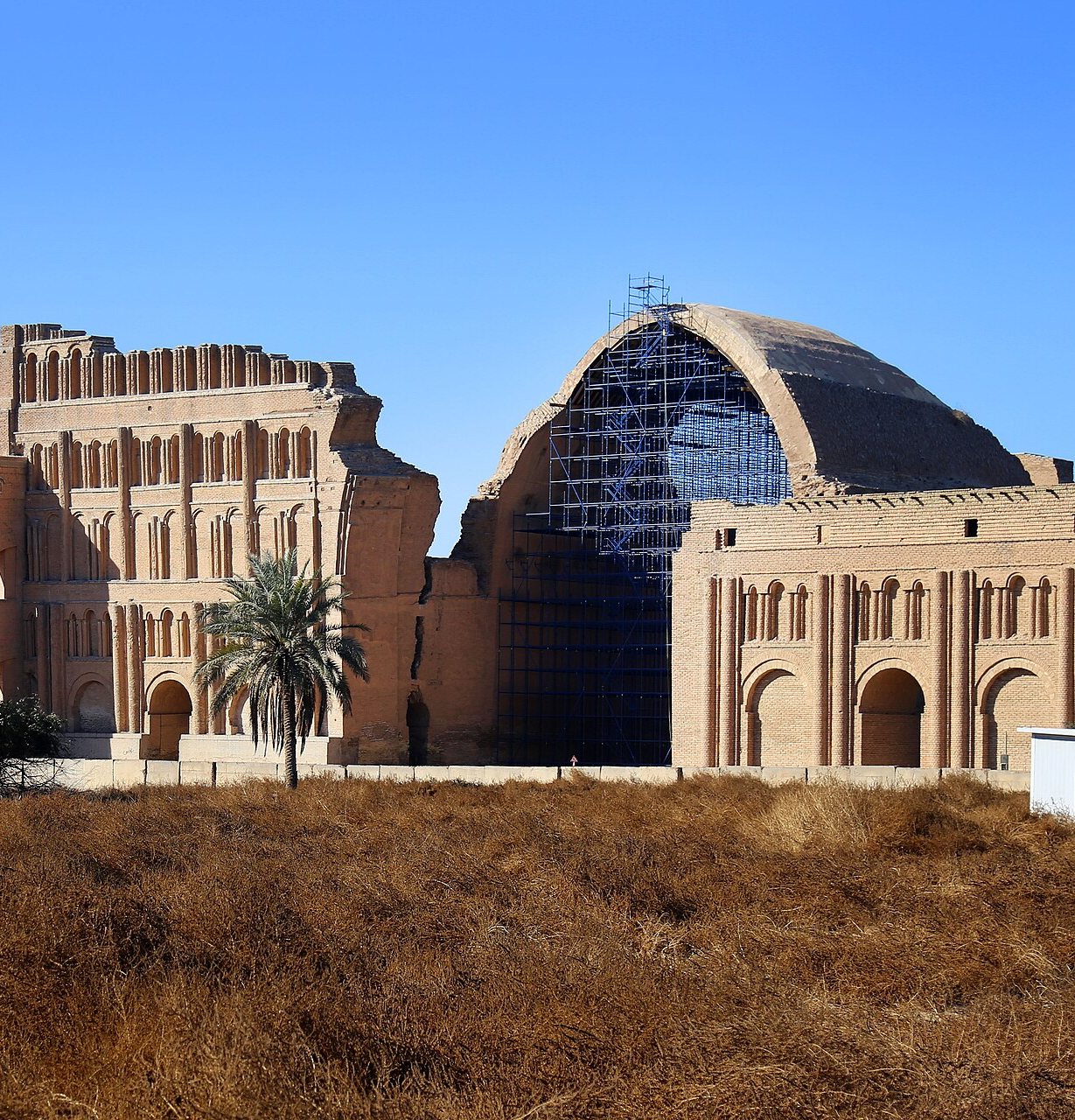
Not a fragment survives and no image of it exists. The great arch of Ctesiphon, Taq Kasra, in today's Iraq is the tangible link to that palace.
More
 Rug knowledge · 2026-11-02
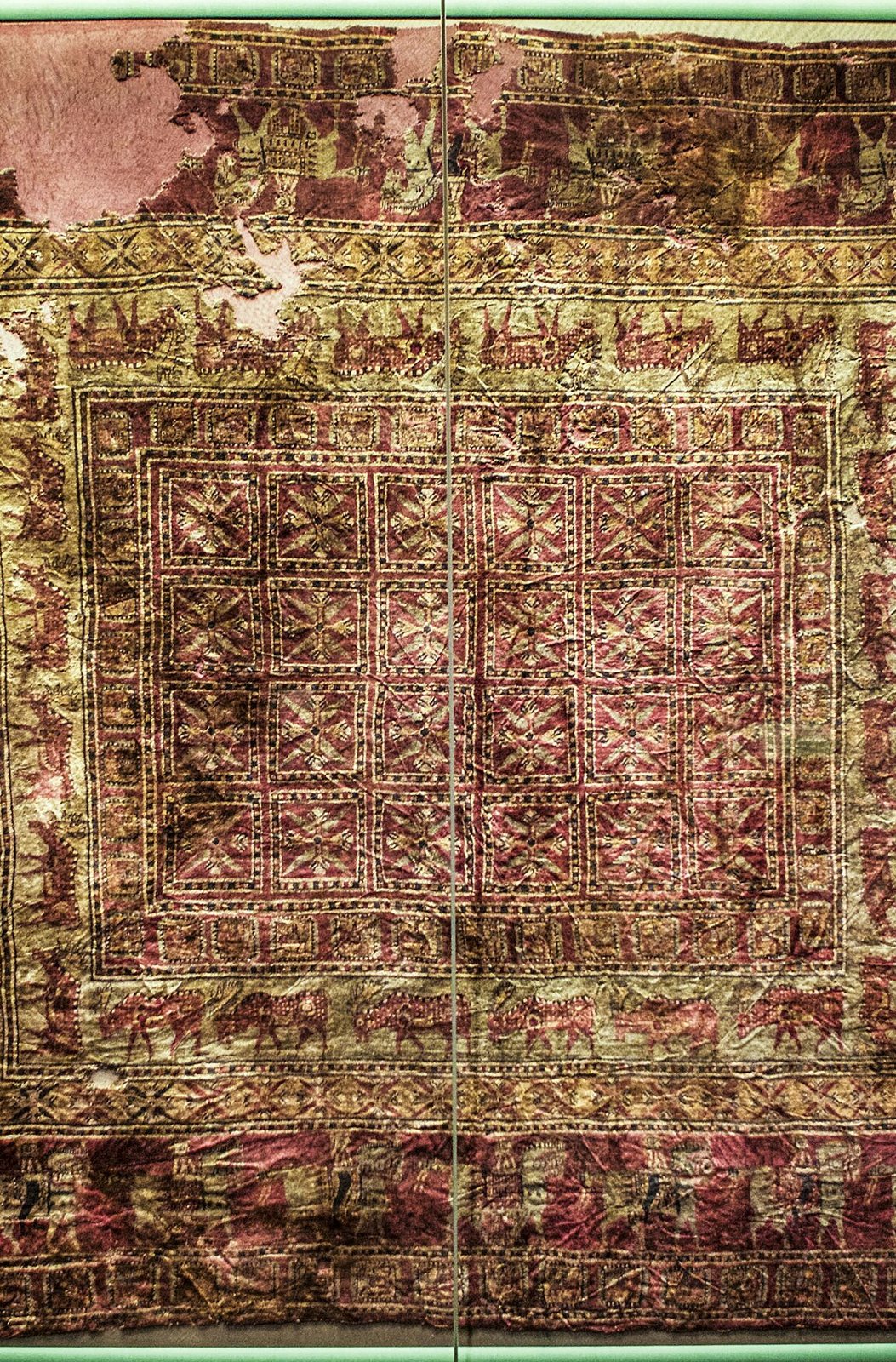
The Pazyryk Carpet is the oldest known pile carpet in the world. Woven around the fifth to fourth century BC, it is now at the Hermitage Museum in St Petersburg.
In 1949 the Russian archaeologist Sergei Rudenko excavated a Scythian noble's tomb in the Pazyryk Valley in the Altai Mountains of Siberia, where he found the carpet.
What saved it was an accident. Robbers had broken into the tomb in antiquity. Water then entered and froze, and the tomb stayed locked in ice. The steady cold preserved wool and colour for some 2,500 years.
The carpet measures about 183 by 200 centimetres, tied in symmetrical knots at around 36 knots per square centimetre. Such fineness suggests that the craft was already long established.
Its design has a field of repeating squares, framed by a border of deer and another of horsemen and horses.
Its origin remains unresolved. Rudenko and many later scholars attributed it to Achaemenid Persia because its motifs resemble the art of Persepolis; others have proposed Mesopotamia or Armenia.
More
 Rug knowledge · 2026-11-02
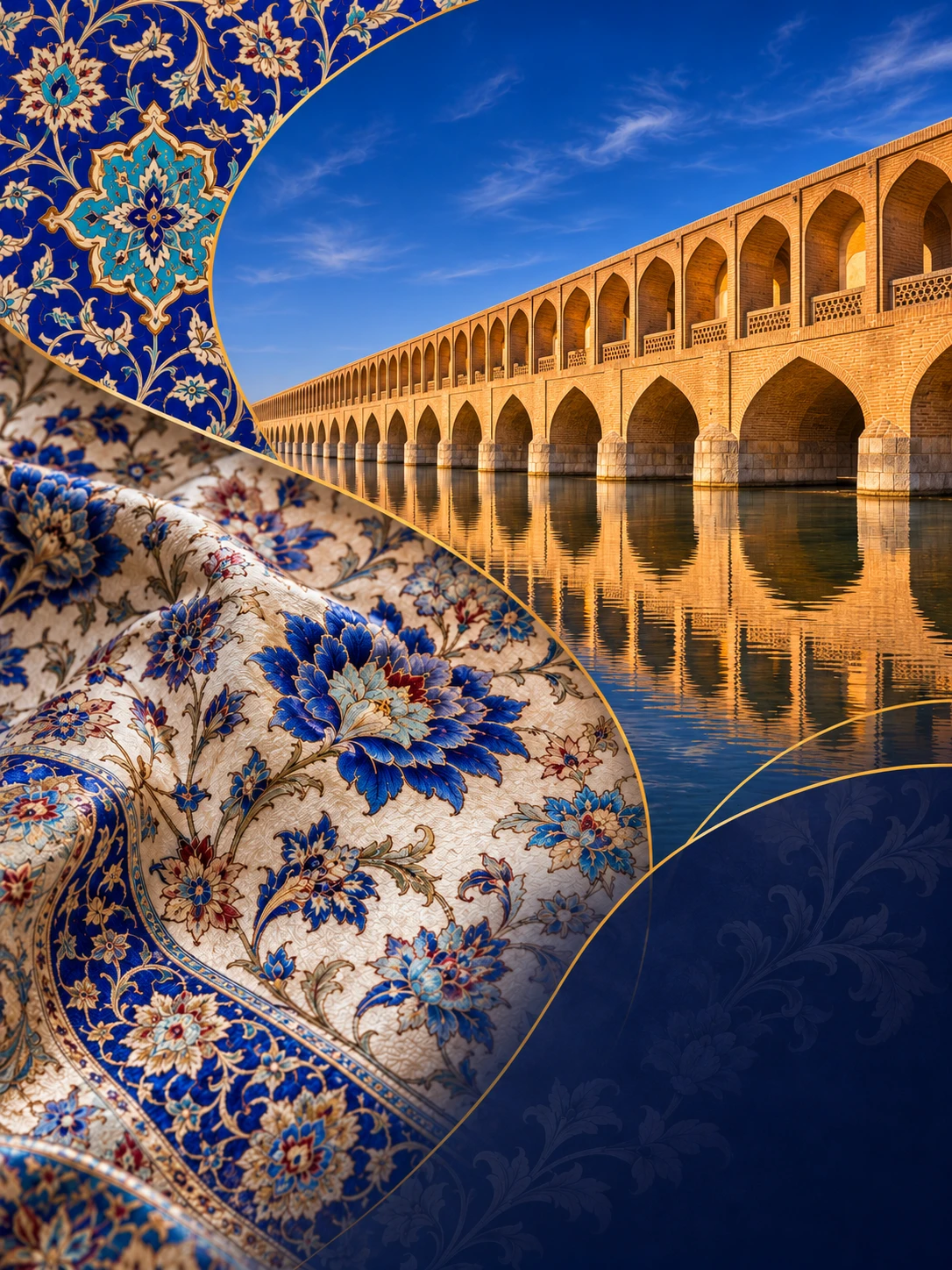
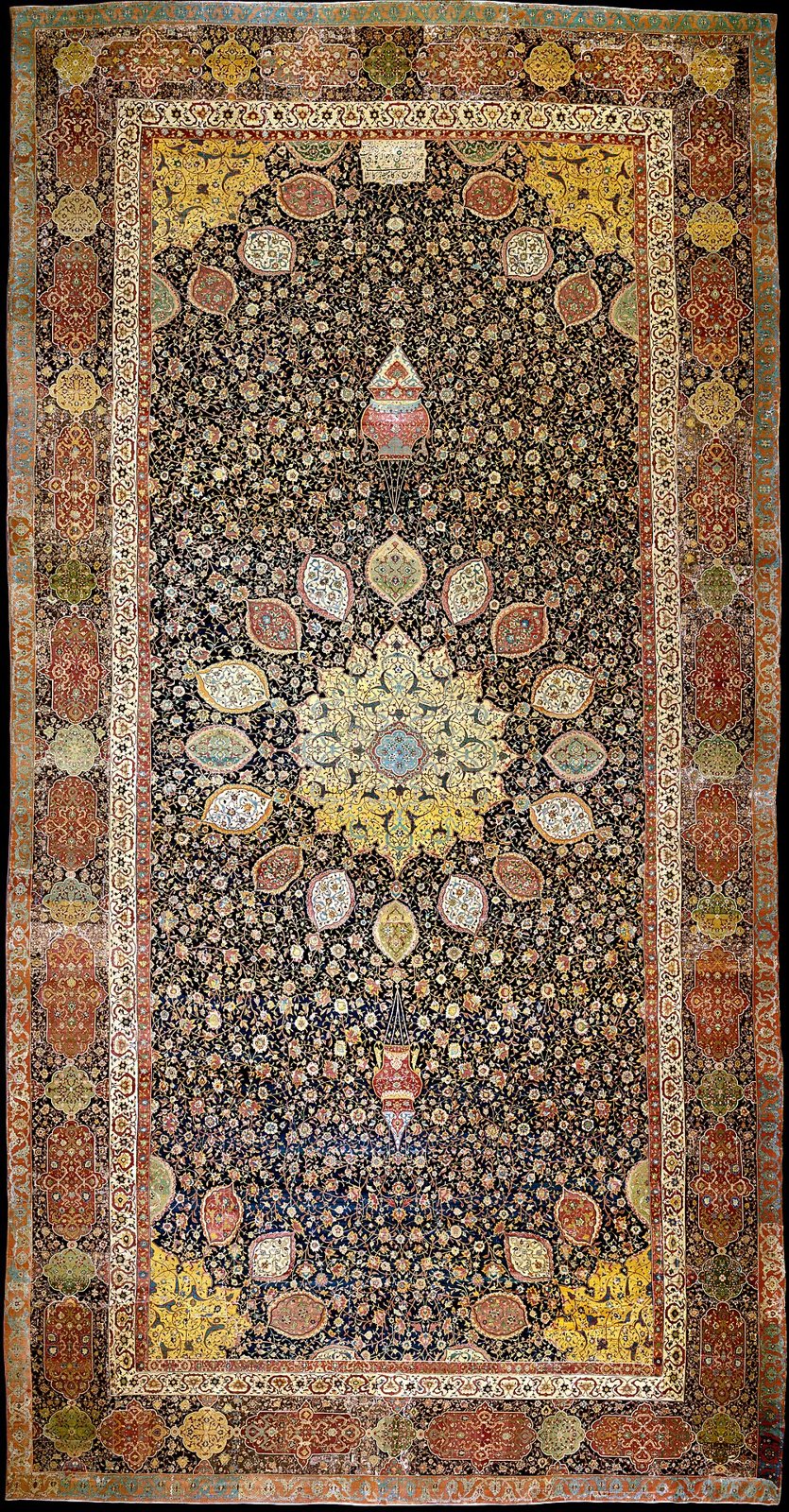
The Ardabil Carpet is one of the most famous carpets in the world. Dated 946 AH (1539–40), it was woven in the reign of Shah Tahmasp of the Safavid dynasty and is the oldest large carpet to bear its own date. It is now at the Victoria and Albert Museum in London.
It was made for the shrine of Sheikh Safi al-Din at Ardabil, the revered ancestor of the Safavids. Where it was woven is not certain: Tabriz is often proposed, and Kashan, Isfahan and Kerman have been suggested too.
The London carpet measures about 10.5 by 5.3 metres, with a wool pile on a silk foundation and around 340 knots per square inch, some 25 million knots in all.
On a deep blue ground, a golden central medallion radiates among flowers and scrolling vines, with two hanging lamps on its axis. A cartouche at one end carries a couplet by Hafez, followed by the name Maqsud of Kashan and the date 946. The V&A notes that Maqsud was probably the court official in charge of the work, and that the phrase "slave of the threshold" expresses humility rather than actual slavery.
The carpet had a twin. In the nineteenth century both left Ardabil and reached Ziegler & Co. of Manchester, and parts of one, including its borders, were used to repair the other. The more complete carpet was sold to the V&A in 1893 for £2,000. Its smaller, borderless twin is at the Los Angeles County Museum of Art.
More
 Rug knowledge · 2026-11-02
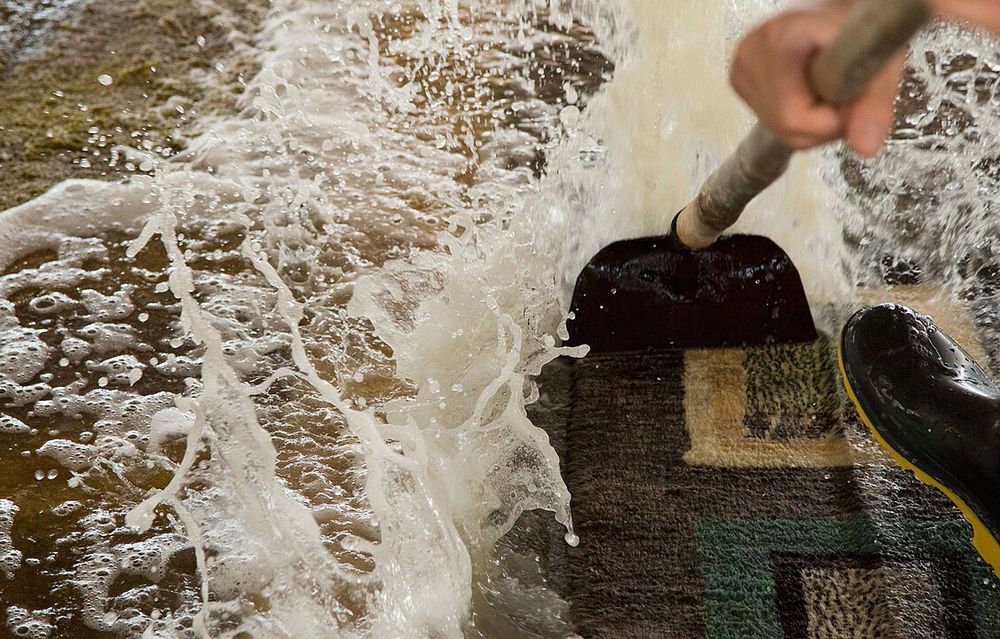
Keep the rug out of long, direct sun, and turn it every few months so that colour and wear stay even.
Vacuum in the direction of the pile and avoid the fringe. Blot spills at once with a clean cloth instead of rubbing. Leave washing and repairs to a specialist.
More
 Rug knowledge · 2026-11-02
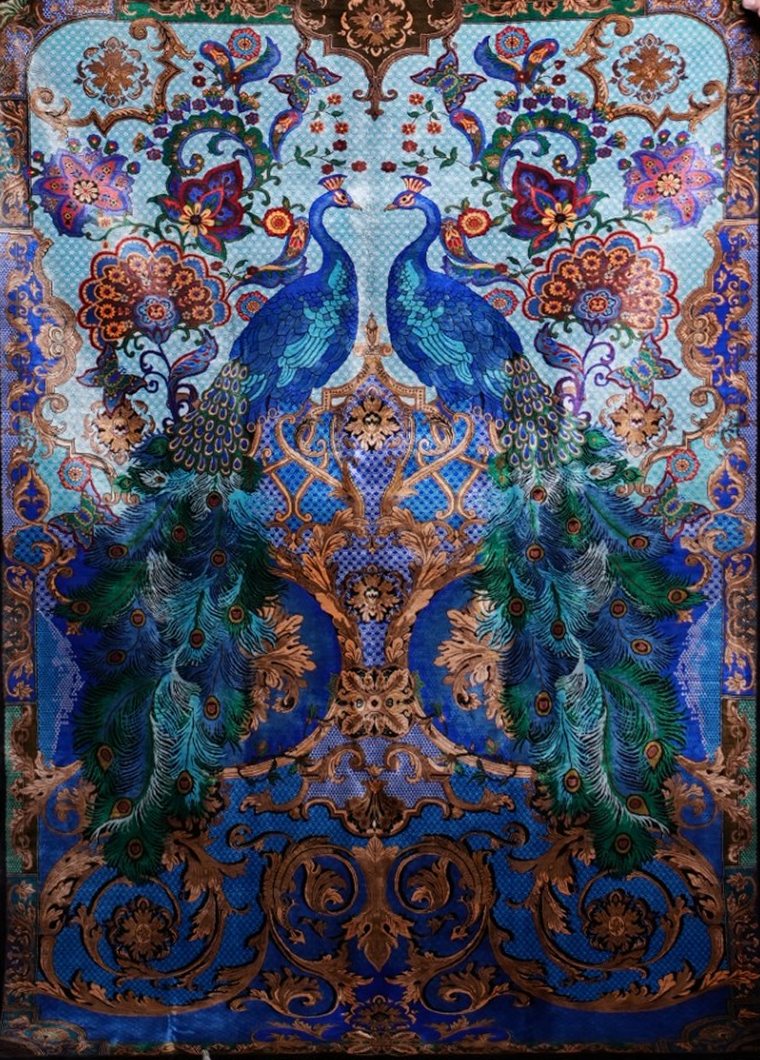
Wool is warm and hard-wearing, and suits busy rooms. Kurk comes from the finest wool fibres and gives a softer surface with more sheen.
Silk is lustrous and delicate. It allows the finest designs and is used mostly for pictorial and very finely knotted rugs.
More
 Rug knowledge · 2026-11-02
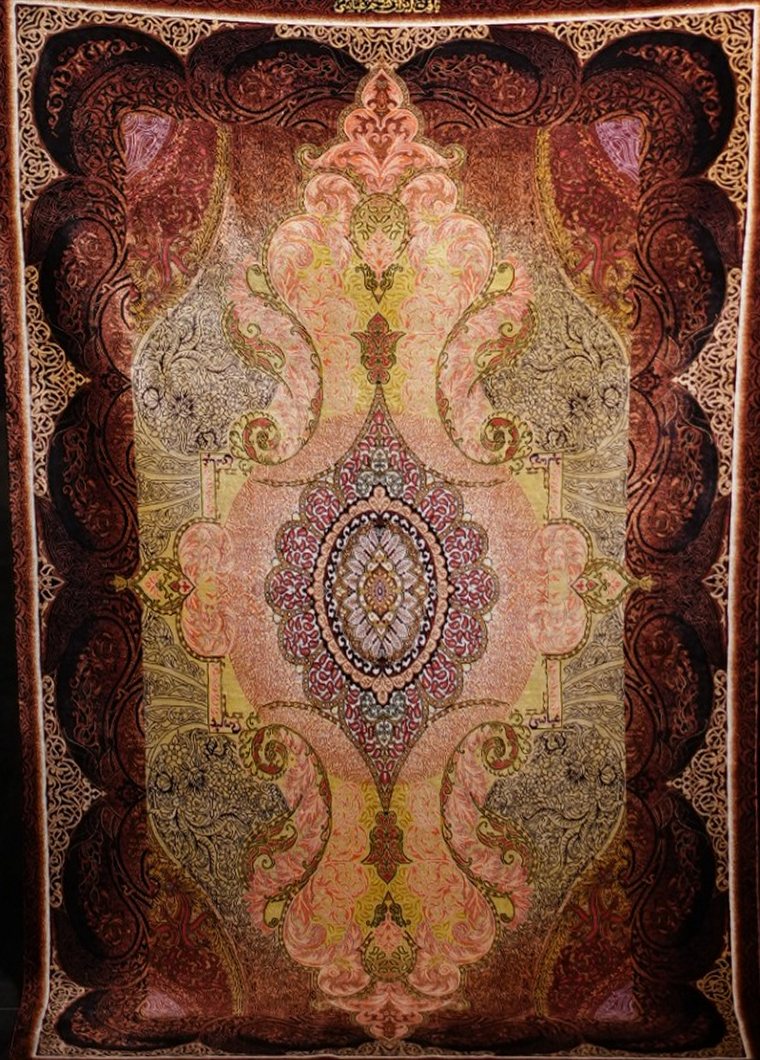
Raj is the number of knots along 7 cm of a rug's width. A 70 raj rug has 70 knots in every 7 cm, or about 100 knots per square centimetre.
The higher the raj, the finer the design and the longer the weaving takes. Raj alone does not set a rug's value, though: design, colour, materials and workmanship matter too.
More